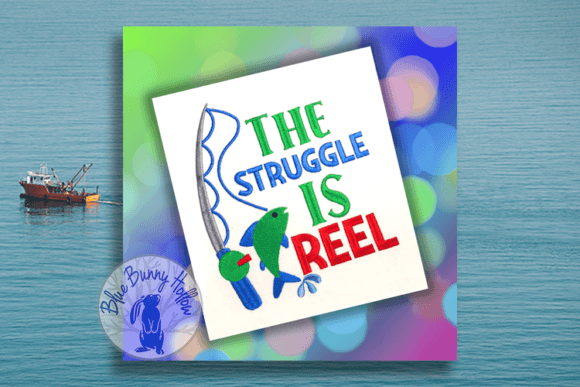
The Struggle is Reel
A Fisherman’s Grin, Not a Fishing Fail
First impression? The Struggle is Reel lands with warm, wry charm—not cartoonish, not sarcastic, but genuinely human. It’s the kind of embroidery design that makes someone pause mid-scroll, smile, and say, “Oh, I know that guy.” The fisherman’s stance is grounded, his grip firm; the fish isn’t flailing wildly—it’s *committed*, line taut, tail arched. That subtle narrative tension—determination meeting resistance—is what gives this machine embroidery design its quiet staying power. It doesn’t scream for attention. It earns it.
Where It Lives Best: Real Projects, Real People
Last week, I prepped The Struggle is Reel for a custom embroidered tote bag destined for a local fly-fishing guide service. Cotton canvas, medium-weight stabilizer, standard 4×4 hoop. The result? Crisp, confident, and instantly legible at arm’s length. No lost detail in the rod curve or the fish’s eye—just clean satin stitch definition and balanced fill stitch density. That’s where The Struggle is Reel shines: on structured, stable surfaces like tote bags, aprons, tea towels, and sweatshirt backs. It holds up beautifully on unisex crewnecks and baby onesies (yes—I tested it on 100% cotton interlock with tear-away + cut-away combo), reading clearly even at 3.5 inches tall.
I also stitched it as an embroidered patch on twill fabric for a small-batch cap line. The shape—slightly horizontal, with clear top-to-bottom visual flow—anchors well on curved brims without distortion. Customers responded to the humor *and* the craftsmanship: “Looks handmade, not mass-printed,” one Etsy buyer wrote. That’s no accident. This design avoids over-detailing—no micro-textures, no fragile thread loops—so it reads cleanly whether you’re stitching it for a holiday gift pillow cover or a boutique’s limited-run kitchen towel set.
Where to Pause—and Plan Ahead
The Struggle is Reel isn’t built for every surface. On ultra-thin fabrics like lightweight rayon or delicate linen napkins, the stitch density may cause puckering unless you dial back tension and use ultra-soft stabilizer. On stretchy knits—think performance tees or baby leggings—test first. A light tear-away alone won’t cut it; add a layer of adhesive stabilizer underneath to lock down movement before hooping.
Dark fabrics demand thoughtful thread color choices. The fish’s eye and the fisherman’s hat brim are small but critical focal points—if your thread blends too much, those details vanish. I recommend testing the embroidery file in both black and white mockups before finalizing your palette. And while the design fits neatly in common hoop sizes, avoid cramming it into anything smaller than 3.75” wide: the fishing rod’s angle and the fish’s tail need breathing room to read as intentional, not cramped.
What It Adds to Your Finished Product
This isn’t just decoration—it’s emotional shorthand. On a personalized gift, The Struggle is Reel signals warmth, shared experience, and lighthearted authenticity. For craft businesses and Etsy sellers, it elevates perceived value: customers see care in composition and confidence in execution, not just a generic fish icon. That translates directly to trust—especially when paired with consistent branding across your digital embroidery file listings, printable mockups, and physical product photography.
It also plays well with others. I’ve layered it beside simple monograms on nursery decor (fishing-themed baby blankets) and paired it with minimalist typography on men’s aprons—never competing, always complementing. Its visual personality is strong but not loud, making it ideal for small shop merchandise where cohesion matters more than flash.
Practical Designer Notes You’ll Actually Use
- Always test on scrap fabric first—especially if using textured weaves (like burlap-inspired tea towels) or layered garments (hoodie pockets).
- Check thread color contrast against your base fabric in natural light—not just screen light. What looks bold on your monitor may mute on navy denim.
- Review stitch density before scaling. Enlarging beyond recommended proportions can expose gaps in fill areas; shrinking too far risks losing the fish’s expression entirely.
- Confirm hoop size compatibility with your machine and project type. If your design assets include multiple formats, verify which version matches your intended use case.
- Inspect small details in your embroidery software: the fish’s gill line, the knot on the fishing line, the texture in the fisherman’s shirt. These are the quiet signatures of a well-crafted embroidery file.
- Test on both light and dark backgrounds using grayscale mockups—this reveals hidden contrast issues before you stitch a single yard of fabric.
- Use proper stabilizer for your fabric type—not just “what’s on hand.” Lightweight cut-away works for stable cottons; mesh adhesive helps with caps and curved seams.
- Verify licensing terms before selling finished products or bundling the digital embroidery file in commercial kits. If resale rights aren’t explicit, assume personal-use-only until clarified.
Final Thought: It’s Not Just About the Fish
The Struggle is Reel succeeds because it respects the person holding the hoop—and the person receiving the finished product. It doesn’t ask for perfection from the embroiderer, nor does it demand attention from the viewer. It simply fits: into a craft fair booth, a baby shower gift basket, a fishing lodge’s staff apparel line, or a small-batch Etsy listing titled “Handmade Gifts for Anglers Who Laugh at Themselves.” That versatility, rooted in smart design judgment and real-world testing, is why I keep The Struggle is Reel in my go-to folder—not as a novelty, but as a reliable, resonant embroidery project partner.