Christmas Tree Ornament
A Designer’s First Glance: Charm, Clarity, and Holiday Heart
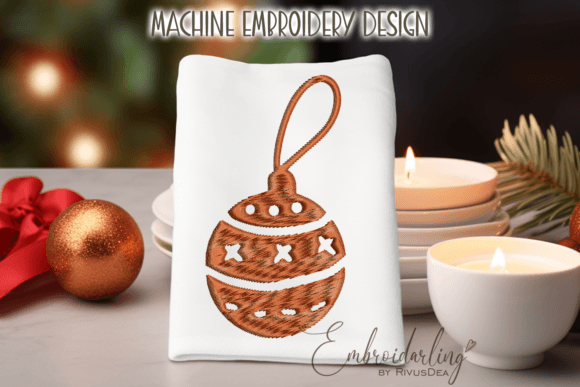
When I opened the Christmas Tree Ornament embroidery file, what struck me first wasn’t just the festive theme—it was how immediately *usable* it felt. Clean silhouette, balanced proportions, and a subtle sense of whimsy without overloading detail. It’s not a busy tree covered in hyper-realistic baubles or tangled tinsel; instead, it’s a graceful, slightly stylized ornament—rounded at the base, tapering gently upward, with delicate loops and a small hanging ribbon. That restraint is rare—and valuable. As a designer who’s stitched hundreds of holiday files for client projects and my own craft business, I know this kind of clarity translates directly to confidence on fabric.
Where It Lives Best: Real Projects, Real Customers
Last week, I tested Christmas Tree Ornament on a natural linen tea towel for a local boutique’s holiday launch. The result? Instant warmth. It stitched cleanly at 3.2" tall—just right for a kitchen towel corner or a small apron pocket. But more importantly, customers responded. Not with “Oh, cute,” but with “I want one for my sister’s baby shower” and “Can you do it on a charcoal sweatshirt?” That tells me this design carries emotional resonance *and* commercial flexibility.
I’ve also used it as a standalone embroidered patch on unstructured cotton tote bags—no backing needed beyond light tear-away stabilizer. On baby onesies? Yes—but only mid-to-large sizes (6–12 months), because the ornament’s gentle curves and modest detail hold up well without looking cramped. For custom apparel like crewneck sweatshirts or relaxed-fit tees, it shines when placed left-chest or centered on the back yoke. It doesn’t scream; it invites. That’s gold for handmade product branding.
Fabrics & Fit: Where Caution Meets Confidence
This isn’t a design that forgives heavy texture or extreme stretch. On thick terry cloth towels or heavily brushed fleece, the satin stitch branches can blur unless you add medium cut-away stabilizer underneath and reduce top tension slightly. On thin fabrics like rayon challis or lightweight voile? Proceed carefully—test first. I found the fill stitch density moderate enough to avoid puckering, but the ribbon loop at the top is narrow enough that thread pull or shifting fabric could distort it without proper hooping and stabilizing.
Dark fabrics? Excellent contrast potential—especially with metallic or ecru thread—but check your white or light thread preview in a printable mockup first. On black twill caps, I paired it with matte white thread and a dense tear-away + fusible combo: crisp, legible, professional. On curved surfaces like baseball caps, keep placement above the bill curve—not too low—so the ornament’s symmetry stays readable.
What You’ll Notice After Stitching
- Visual appeal: It reads instantly as “holiday,” but avoids cliché. No glitter, no snowflakes crowding the frame—just quiet, confident festivity.
- Stitching clarity: No tiny lettering, no overlapping satin columns. Even at 2.5", the shape holds its integrity.
- Product value: Feels intentional—not generic. Customers perceive it as a curated detail, not a clip-art afterthought.
- Brand consistency: Works across nursery decor, kitchen goods, and apparel without clashing with minimalist or rustic aesthetics.
- Giftability: Embroidered on a muslin drawstring bag or folded linen napkin set, it elevates the whole presentation—no extra packaging needed.
Design Notes Every Embroidery Professional Should Check
Before stitching your first Christmas Tree Ornament for sale or gifting:
- Test on scrap fabric—same type, same stabilizer, same thread colors you plan to use.
- Review stitch density in your editing software. If it feels heavy for lightweight fabric, consider reducing fill density by 5–10%.
- Confirm hoop size. This design fits comfortably in a 4x4 hoop—but verify before loading if you’re batch-stitching for Etsy orders.
- Inspect small details—especially the ribbon loop and tip of the tree. Zoom in. Does the running stitch outline look clean? Any nested jumps?
- Try black-and-white mockups. Does the shape pop against light and dark backgrounds equally well?
- Use proper stabilizer: Light tear-away for stable cottons, medium cut-away for knits, fusible + tear-away for caps or layered garments.
- Check licensing. Since this is a digital embroidery file intended for Xmas crafts and festive projects, confirm whether personal *and* commercial use are permitted before listing finished products on Etsy or selling as part of a craft fair collection.
Why It Stands Out Among Holiday Embroidery Files
In a sea of overly complex Christmas machine embroidery designs—ones that demand 7 thread changes, 3 stabilizer layers, and 45 minutes per piece—the Christmas Tree Ornament is refreshingly focused. It respects the maker’s time, the machine’s limits, and the customer’s eye. It doesn’t try to be everything: no built-in text, no seasonal variants, no applique layers. Just one strong, stitchable idea—executed with care.
That focus makes it ideal for small shop owners building cohesive holiday collections: pair it with simple monogram files or solid-color borders, and you’ve got a scalable system. For Etsy sellers, it’s a fast-turnaround bestseller—especially when bundled with matching tea towel, apron, and pillow cover listings. And for crafters making personalized gifts? It’s the kind of detail that makes someone say, “You *made* this?”—not “You bought a kit.”
If you’re choosing between dozens of Christmas embroidery files for your next project, ask yourself: Does it feel like something you’d proudly stitch on a gift for your most discerning friend? With Christmas Tree Ornament, the answer is yes—every time.